
You write the first sentence, imagine someone reading it, and replace it with a sentence you can defend.
Nothing has been published. Nobody has been invited. Still, the audience has entered the room.
This happens easily in tools built around sharing. A visible Publish button, follower count, comment thread, or document full of other people's cursors can change a draft before it has discovered what it wants to say. The writer begins explaining, softening, and arranging the page for a response that has not happened.
Private writing creates a different first step. The page can be repetitive, uncertain, self-contradictory, or wrong. It can hold a thought long enough for you to find out whether you mean it.
Privacy alone does not produce good writing. It does remove one common reason we stop before the honest sentence arrives.
The imagined audience edits earlier than you think
Writers often describe self-censorship as deleting a shocking confession. Most of it is quieter.
You add context because a reader might misunderstand. You choose the more respectable example. You turn a specific person into "someone I knew." You make the ending hopeful because leaving it unresolved feels impolite. You explain the joke until it stops being funny.
Some of those choices belong in revision. They may protect another person's privacy, improve accuracy, or help a real audience follow the piece. The problem is timing. When public consequences govern the first draft, you cannot see the material before deciding how to present it.
A private writing space separates discovery from disclosure. First write the version that shows you what is there. Later decide what another person should see.
Private is a workflow, not a mood
A blank page can feel intimate and still be one click from publication. A private-writing workflow needs clearer boundaries.
Ask four questions before trusting a tool with sensitive work:
- Is the writing private by default, or does the product assume sharing?
- Who owns the text, and what license does the service receive?
- When is the text sent to AI or another provider?
- Can you export and delete the material, and what remains afterward?
These questions are less romantic than a leather notebook. They are also what turns the promise of privacy into something you can evaluate.
Riikee is organized around a private writing practice. The editor has no public feed, follower count, reactions, or built-in publishing path. A draft can remain a draft. This reduces performance pressure, but it does not make the page immune to every digital risk.
Use a two-room writing process
It helps to think of writing as two rooms.
The first room is private. You generate material, follow associations, write around gaps, and let incompatible versions sit beside each other. You do not need to know whether the page will become an essay, letter, scene, or nothing.
The second room has a reader. Here you verify claims, consider consent, remove details that are not yours to reveal, shape the argument, and decide where the work belongs.
Many stalled drafts come from trying to occupy both rooms at once. The sentence must be honest enough to discover something and safe enough to publish immediately. Very few sentences can do both on the first attempt.
Mark the handoff. Create a duplicate, export a copy, or add a clear note such as "reader draft begins here." Do not let the existence of a possible audience convert the whole private archive into publication material.
Write the sentence you keep circling
A private session is useful when it gets more specific, not merely more confessional.
If you keep writing "I felt bad about the meeting," ask what happened in the room. Which sentence did you rehearse but never say? What detail keeps returning? What account of the event would you give if you did not have to prove you were right?
Set a short boundary, perhaps fifteen minutes, and write without preparing the reader. You can begin with one of these lines:
- "The part I keep leaving out is..."
- "If nobody needed me to be reasonable, I would say..."
- "What I remember most clearly is..."
- "I do not know whether this is true, but..."
These are drafting devices, not instructions to publish the result. The page may contain exaggeration, anger, or a mistaken memory. Privacy gives you room to see it. Revision gives you the responsibility to decide what survives.
Keep ownership separate from access
Riikee's terms say that you retain ownership of the writing you create. The service receives a limited license to host, process, display, back up, and transmit the content as needed to provide and secure the features you request. That license does not transfer authorship.
Ownership does not mean that no system can access the data. A cloud writing service must process text to save, search, export, or analyze it. Infrastructure and service providers may handle data under their agreements and the product's privacy policy.
Riikee says it does not sell your writing or personal information, use the text for advertising profiles, or use your writing to train its own AI models. Read the Privacy Policy and Terms of Service for the full scope and exceptions. If the distinction between ownership and technical access matters to you, do not settle for the word "private" on a landing page.
Know when AI enters the room
Riikee has two AI paths, and both are optional.
When you choose an AI writing command, Riikee sends the instruction and relevant writing to its server and an AI provider. Depending on the command, that may include a topic, selected text, nearby context, a title, or the current practice. The response stays separate until you choose to insert or accept it.
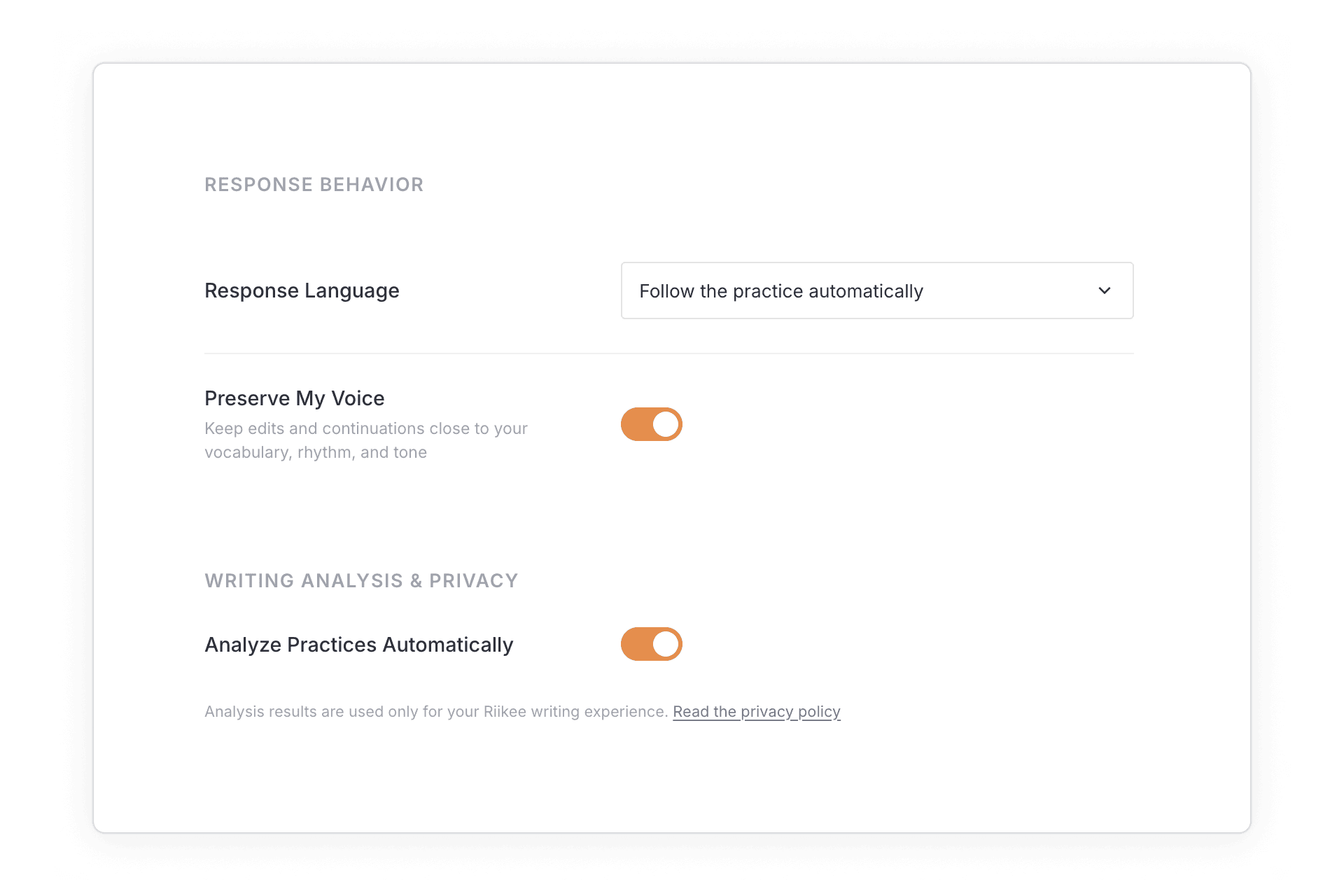
Automatic writing analysis is a separate setting. When enabled, Riikee may analyze eligible saved practices after the writing settles and store structured results such as a summary, themes, genre, written mood, language, and confidence. These results can appear in Information, Library, and Writing Portrait.
Turn automatic analysis off in Settings → AI if you do not want new background analyses. Existing results remain until the related writing or account is deleted, or until a newer result replaces them.
Sensitive writing deserves a simple rule: do not send text to an AI feature merely because the button is available. Decide whether the result is worth the processing first.
A private draft still needs security
Riikee uses encrypted network connections, authentication, managed access controls, and infrastructure providers. No online service can promise that loss, misuse, or unauthorized access will never occur.
Riikee does not claim end-to-end encryption. That means it is not the right place for material whose security requirement is that only you hold the key and the service operator cannot decrypt the content. Use a tool that documents and verifies that model when you need it.
For ordinary private writing, basic account care still matters:
- use a strong password that you do not reuse elsewhere;
- protect the email or identity account used for recovery;
- keep the device and browser updated;
- sign out on shared computers;
- export writing you cannot afford to lose.
Privacy includes resilience. A page that nobody else can read is not useful if one cleared browser or lost device can erase the only copy.
Guest drafts and signed-in writing are different
Riikee can let a guest begin writing before creating an account. That lowers the distance between an idea and the page, but the storage boundary is important.
A guest draft normally remains in the browser and device where it was written. Clearing browser data can permanently erase an unsynced draft or recovery copy. It does not automatically become part of your account history.
Sign in and complete the supported save flow before leaving if the writing matters. A private local draft is still fragile when it has only one home.
The same principle applies to any writing app. Know whether the page is local, synced, exported, or merely cached. "Saved" should name a location you understand.
Export is part of privacy
Privacy is easier to trust when leaving is possible.
Riikee lets guests and Basic members export TXT. Pro members can also export Markdown, Word, and PDF. These formats make it possible to keep a backup, move a draft into another editor, or begin the reader-facing stage somewhere else.
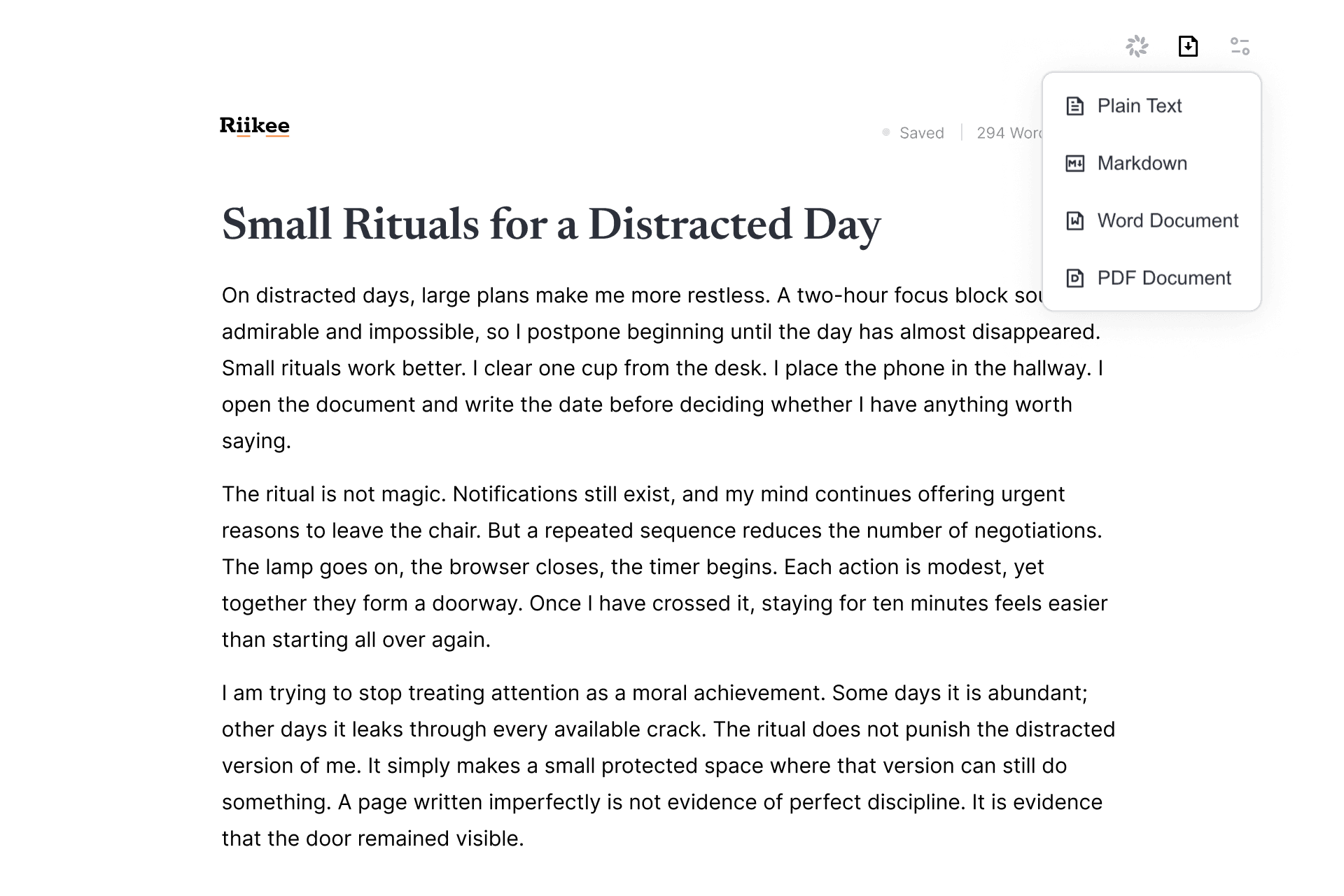
Open the exported file before treating it as your backup. Formatting and metadata may not transfer exactly. For long-running journals or projects, keep a regular export schedule rather than waiting until you plan to leave.
Data portability has a psychological benefit too. When the writing is not trapped, you can choose a tool for the work it supports now rather than fearing the cost of changing later.
Understand what deletion removes
Deleting a current practice removes it from active writing views. Historical deletion has a boundary: Riikee removes the title and body but may retain limited tombstone, session, or aggregate data such as dates, deletion time, and word-count activity. This allows past statistics and streaks to remain stable without keeping the deleted prose.
Backups and provider systems may retain deleted data for a limited period before scheduled removal. Deleting an account follows the process described in the Privacy Policy, and legal obligations can create additional retention limits.
This is less tidy than saying "delete means every trace vanishes instantly," but it is more useful. Before storing sensitive material anywhere, understand whether deletion covers the text, metadata, backups, exports, and copies you shared elsewhere.
Protect the privacy of other people
A private page gives you freedom to write about people who did not choose to enter the draft. That freedom is valuable during discovery and still carries responsibility.
When the writing moves toward a reader, ask what belongs to you. Your experience and interpretation are yours to explore. Another person's medical details, private messages, address, or identifiable history may not be yours to publish.
Revision can change names, remove identifying combinations, compress events, seek consent, or keep the piece private. Do that work in the second room. If you sanitize every detail before you understand why it matters, the draft may lose the truth you needed to examine. If you publish the raw private version, someone else may bear the cost of your discovery.
Privacy for the writer is not permission to ignore privacy for everyone else.
Build a private first-draft ritual
The tool helps, but the ritual makes the boundary believable.
- Open one page that has no sharing or publishing step in the session.
- Choose a short duration rather than an output quota.
- Name the imagined reader who keeps interrupting, then set that reader aside.
- Write the specific version without deciding whether it is fair enough to publish.
- End with one line about what the page needs next.
- Do not move the draft into the reader room until another session.
The gap between drafting and sharing can be an hour or a month. Its length matters less than the fact that it exists.
If you use Riikee Focus Mode, a fifteen-minute session can provide the boundary. The session can enter your writing history without making the text public. When you return, the note at the end gives you somewhere to begin.
Questions about private writing
Is Riikee writing public?
Riikee is built around private account-based writing rather than a public feed. It does not add publishing, follower, reaction, or audience controls to the editor. You decide if and where exported writing is shared later.
Do I own what I write in Riikee?
Yes. You retain ownership. Riikee receives limited rights needed to host, process, secure, back up, and provide the service.
Does Riikee use my writing to train AI?
Riikee does not use your writing to train its own AI models. Text needed for an AI command or enabled automatic analysis may be processed by third-party model and infrastructure providers under the Privacy Policy.
Is Riikee end-to-end encrypted?
Riikee does not claim end-to-end encryption. Choose a tool with a documented and verified end-to-end model if that is a requirement for your material.
Is a guest draft backed up?
A guest draft normally remains in the browser and device where it was written. Clearing browser data may erase it. Sign in and save, then export important work.
Can I write privately and publish later?
Yes. Keep discovery and publication as separate stages. Export the stable draft, create a reader-facing copy, and revise that copy for accuracy, consent, and context.
Does deleting a practice remove all related data immediately?
Deleting removes the title and body, but limited tombstone, session, or aggregate data may remain for historical statistics. Backups may retain deleted data for a limited period before scheduled removal.
The private page is where you learn what the public page might become. Let the first version be uncertain. Give it security, an exit route, and enough time to tell you something before it has to tell anyone else.