
The reminder arrives at 8:00 p.m. You dismiss it. The next evening it returns, now carrying a little more guilt. By the end of the week, even opening the writing app feels like answering a message you have ignored for too long.
This is the wrong moment to demand a heroic session. It may be the right moment to take a writing break on purpose.
A deliberate break is different from drifting away. You decide that writing will be quieter for a while. You stop the prompts that make rest feel like failure, keep the work and history you already made, and leave yourself a specific way to return. The pause has a boundary even when it has no fixed end date.
That last part matters. Most writers do not lose a writing habit because they rested. They lose it because returning becomes vague, emotionally expensive, or tied to making up everything they missed.
First decide whether you need a break or a smaller session
Not every difficult day calls for time away. Sometimes the problem is simply that today's target is too large.
Try a smaller session if you still want contact with the work but cannot manage the usual amount. Ten minutes of drafting, a paragraph of notes, or one pass through a troublesome scene may be enough. A smaller session keeps the thread in your hands.
A break is more useful when the writing itself has become another source of pressure. You may be opening the draft only to protect a streak. Reminders may irritate you instead of helping. You may need to finish a demanding week, travel, recover from an illness, care for someone, or think about whether the current project still deserves your attention.
The distinction is practical:
| What is happening | Better response |
|---|---|
| You want to write but the usual goal feels too large | Lower today's floor |
| You need several days without prompts or expectations | Take a timed writing break |
| You do not know when you will be ready | Take an open-ended break and leave a return note |
| One project is exhausting you but writing still feels welcome | Pause the project, not the whole practice |
Calling every missed day a break can hide a routine that needs repair. Calling every need for rest a discipline problem does more damage. Name what you need before choosing the tool.
Give the writing break a clear boundary
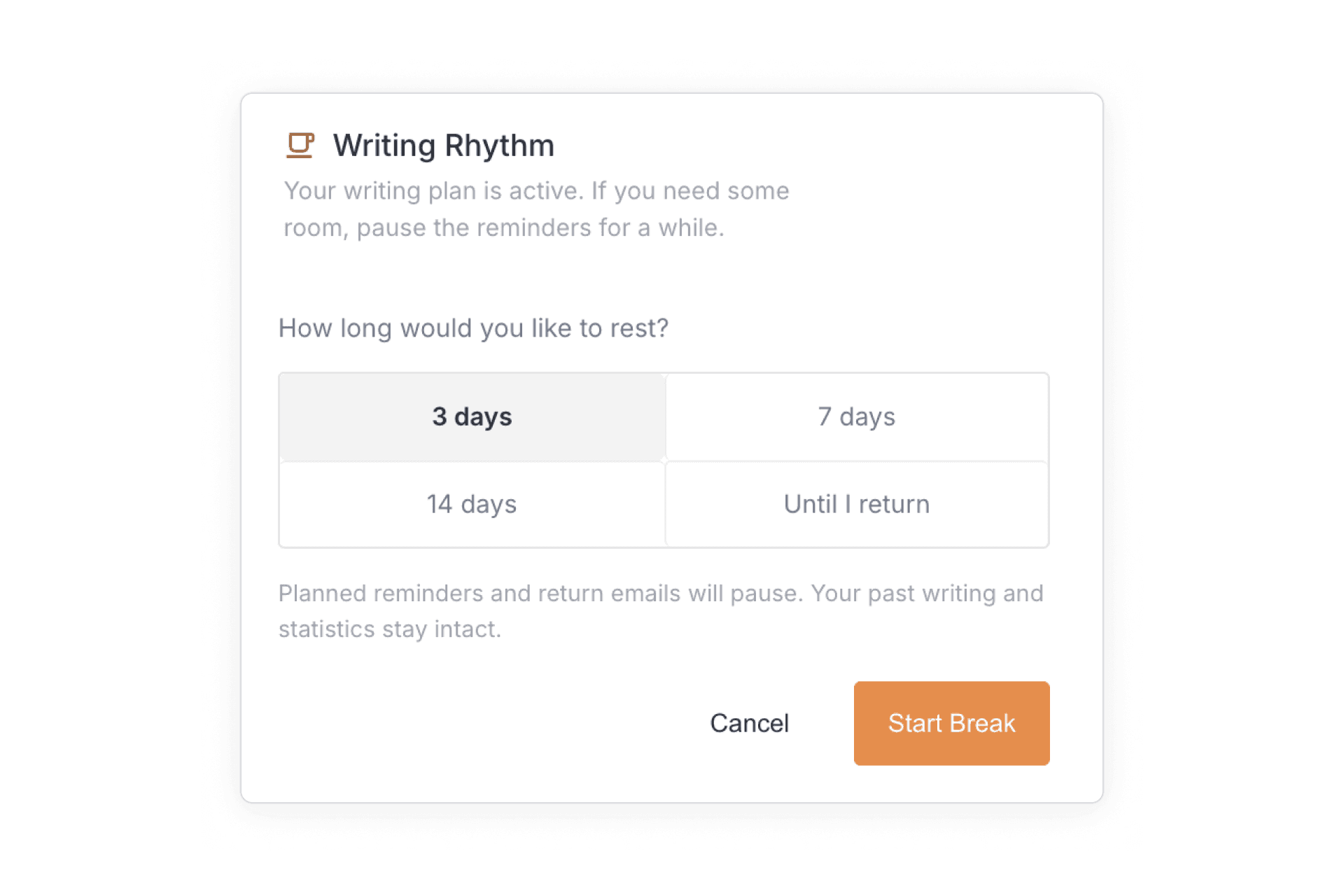
In Riikee, open Settings → Writing to pause for 3, 7, or 14 days. You can also choose an open-ended break.
The duration is not a test of how tired you are. Choose it by asking what needs to change before you return.
A three-day break may cover a crowded weekend or the final push on another deadline. Seven days gives you a full cycle of work and home life without writing prompts. Fourteen days creates enough distance to notice whether you miss the project, the routine, both, or neither.
Use an open-ended break when a return date would be fiction. This does not mean you are quitting. It means you would rather resume by choice than watch an arbitrary date become another promise you failed to keep.
Timed breaks end automatically after the selected date. You can resume early from Settings at any time. An open-ended break continues until you choose to return.
Know what pauses, and what does not
Riikee stops optional writing reminders and recall prompts during a deliberate break. If you are following the 14-day writing guide, the guide pauses too.
Your practices, Writing Sessions, achievements, and other writing history remain. Taking time away does not delete the evidence that you wrote before the break.
There is one limit worth understanding: a break does not freeze or rewrite the normal rules for daily goals and streaks. The quiet days are still days you did not meet a writing goal. Riikee does not disguise them or move activity to another date.
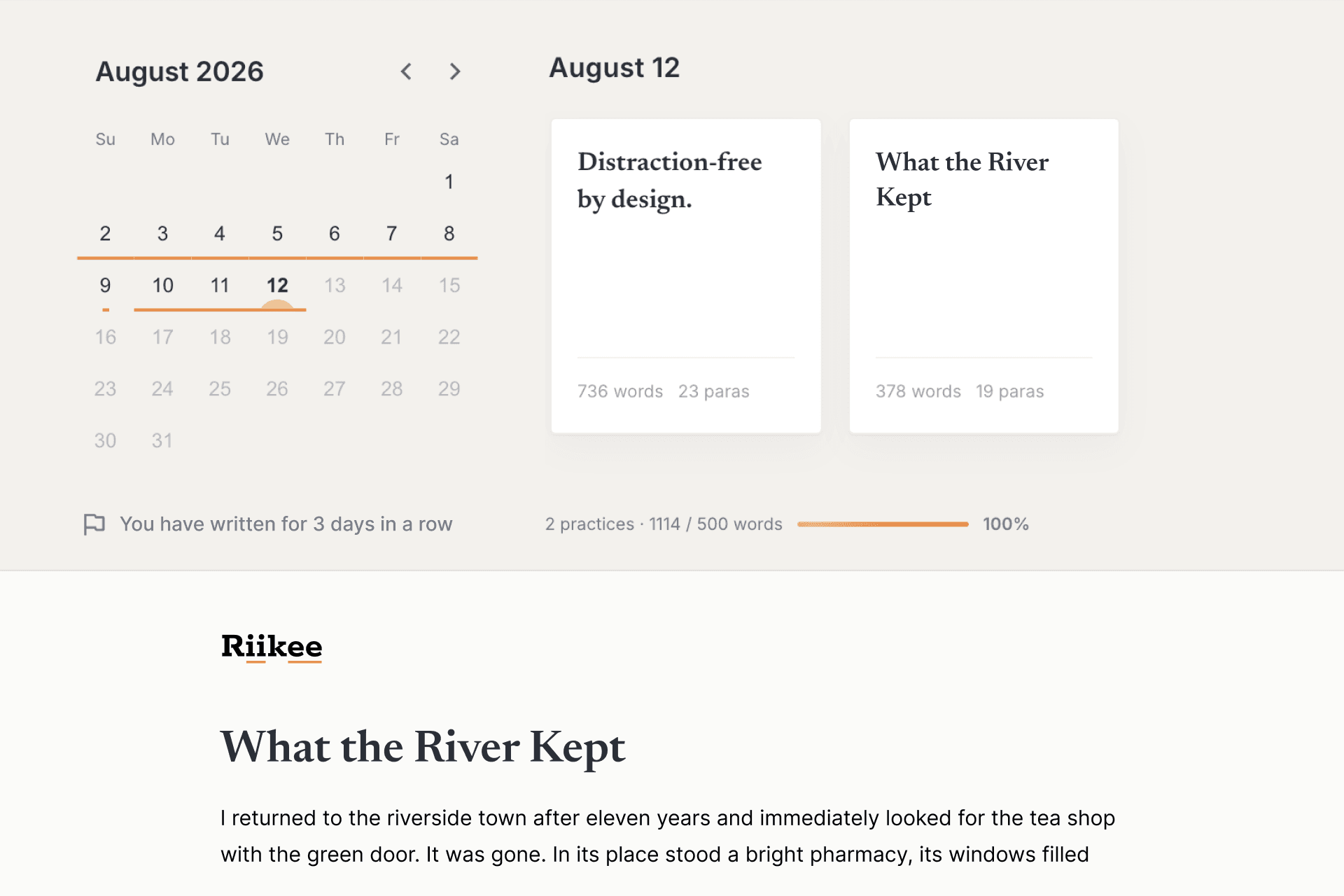
This is more honest than a streak-preservation feature. A break should remove pressure, not alter the record. When you return, the calendar can show a gap and still show all the writing around it.
The same principle applies outside Riikee. Do not spend a rest period inventing technicalities that let you claim you never stopped. Write "on break" in your notebook or calendar. Let the pause be visible. A habit can contain blank days without becoming meaningless.
You are still allowed to write
A deliberate break is not a lock on the editor. You can open Riikee and write whenever you want. Perhaps a sentence arrives in the shower, or the solution to a chapter appears on day five. You do not need to wait for the selected date to capture it.
What changes is the expectation. During the break, an unexpected paragraph is a gift rather than proof that you should restart the full routine immediately.
If you do feel ready, resume early in Settings. That restores the paused guidance. Until then, the 14-day writing guide remains paused even if you write during the break.
This separation protects the meaning of the pause. Writing because you want to is different from writing because a notification found the sore spot.
Pause the 14-day guide without losing your place
Riikee's optional 14-day writing guide is based on meaningful writing days, not an unbroken two-week calendar run. A completed Writing Session with at least 90 seconds of active writing advances one step, and only one step can advance on the same local calendar date.
Skipped days do not erase guide progress. A deliberate break pauses it without resetting it. When you resume, you continue from the step you had reached.
That makes the guide useful for rebuilding after time away. It does not ask you to squeeze fourteen sessions into fourteen consecutive dates. After day 7, it offers a review of your writing days, active minutes, words written, and usual writing time. After 14 writing days, you can choose a daily, three-days-a-week, or flexible rhythm based on what happened.

The guide's behavior offers a useful model even if you do not use it: count completed returns, not calendar perfection.
Leave yourself a return note before you go
The most useful work you can do before a writing break takes about two minutes. Leave a note that removes the first decision from your return.
Write down:
- where you stopped;
- the next small action;
- anything you should not try to solve yet;
- the minimum session that will count as a return.
For example:
I stopped after the kitchen scene. Next, write the phone call without revising the dialogue before it. Ignore the opening paragraph for now. Ten minutes is enough on the first day back.
This note is better than "continue chapter four." It gives your future self a visible starting point and permission to avoid the problem that would otherwise swallow the whole session.
If the break is open-ended, add one condition for checking in. It might be "after the move," "when the client project ships," or "on the first quiet Saturday next month." A check-in is not a demand to write. It is a moment to decide whether the pause still helps.
Do less during the first session back
Writers often return with an apology disguised as a plan. They set a larger target, reread the whole manuscript, and promise to recover the missing week before lunch. The first session becomes so heavy that the second never happens.
Treat the first return as a reopening, not a repayment.
- Read the return note before you read old pages.
- Set a short session or a modest word goal.
- Do the next action you named.
- Stop when the small goal is complete, even if you could keep going.
Stopping early can feel wasteful when energy has finally returned. It also leaves a clean edge for tomorrow. The goal of the first session is not maximum output. It is to make the second session ordinary.
If you did not leave a return note, spend five minutes writing one now. Describe what you remember about the project, what feels uncertain, and the smallest piece you can move today. That still counts as returning.
Use a three-session restart plan
One good day can be an accident. A short sequence helps a writing habit settle again without turning the restart into a campaign.
Session one: recover contact
Work for ten to fifteen minutes. Follow the return note or write a short account of where the piece stands. Do not begin with a complete reread unless the project is genuinely short.
Session two: produce something you can keep
Write one scene, paragraph, exchange, or page of notes that belongs to the project. Keep the target small enough that you can finish it in the time available.
Session three: choose the next rhythm
Look at the first two sessions and decide what you can repeat. That may be daily, three times a week, or flexible. If reminders help, set them near a time when you already managed to write. If they do not, leave them off.
The three sessions do not need to occur on consecutive days. Their job is to turn "I should start writing again" into recent evidence that you already did.
Do not use Catch Up as punishment
Riikee may offer eligible Pro writers Catch Up for a missed day. It can credit that date under the rules shown in the product, while the words remain attributed to the day when they were actually written. The same words are not added twice to daily or lifetime totals.
Catch Up is an option, not a debt collector. You do not have to repair every blank square after a writing break. Using it to satisfy a specific missed date may matter to you, but trying to erase an entire absence can make the return feel like unpaid work.
If your first thought after resting is "I owe the tracker 4,000 words," step away from the total. Write today's small session. The missing days are not a backlog.
Review the habit after enough days have passed
Do not judge the restart from one awkward session. Returning often feels clumsy because you are recovering names, choices, and the emotional weather of the draft.
Wait until you have several sessions, then look at Writing Journey or your own notes. Ask whether the new rhythm is workable. Check when you wrote, how much active time the sessions needed, and whether the chosen reminder helped you begin.
Avoid using the statistics to prove that the break was a mistake. The useful comparison is not "Did I instantly match my best week?" It is "What made returning easier this time?"
You may learn that the old daily goal was too high. You may find that three reliable writing days suit the project better than seven reluctant ones. Or the break may confirm that you do not want to continue this project. That is not a habit failure. It is information about where you want the habit to go next.
Frequently asked questions
Will a writing break delete my work or history in Riikee?
No. A deliberate break does not delete practices, Writing Sessions, achievements, or other writing history. It pauses selected prompts and guidance.
Does a break protect my writing streak?
No. A break does not freeze or rewrite the ordinary rules for daily goals and streaks. Its purpose is to give you quiet, not to make the gap disappear.
Can I write before the break ends?
Yes. You can still open Riikee and write. You can also resume early from Settings when you want the paused guidance to continue.
What happens to the 14-day writing guide?
The guide pauses at your current step and continues after you resume. Skipped days and deliberate breaks do not erase its progress.
How long should a writing break be?
Choose the shortest period that gives you real relief without forcing a false return date. Riikee offers 3, 7, and 14 days, plus an open-ended option. If you need one quiet evening rather than several days, lowering the session goal may be enough.
How do I restart a writing habit after a long break?
Begin with one defined action and a short session. Do not start by recovering missed word counts or rereading everything. Use the first session to regain contact, the second to make something you can keep, and the third to choose a realistic rhythm.
A writing break works when it makes room for rest and keeps the return concrete. Pause the prompts. Keep the record honest. Leave one clear instruction beside the draft. When you are ready, open the page and do that one thing.