
The week contained two good writing sessions, one difficult revision, and a Wednesday when you did not open the draft. Then the tracker reduced all of that to a broken streak.
That is a poor reading of the week. The number may be accurate, but it has answered the least useful question.
Writing progress is hard to track because the work changes shape. Drafting adds words. Revision may remove them. Research can occupy an evening without moving the word count at all. A short session can solve the problem that blocked a chapter for days, while a long session can produce pages you later cut.
A writing tracker cannot judge the quality of those choices. It can still help if you use each measure for a specific decision. The goal is to learn what makes returning easier, how much time the work usually needs, and whether a project is moving at a pace you can sustain.
Begin with a decision, not a dashboard
Before you look at writing statistics, decide what you want to know.
"Am I a serious writer?" is too large for a chart. "Could I finish this essay with three more sessions like last week's?" is answerable. So is "Do I write more consistently before lunch or after dinner?"
Useful questions tend to produce small changes:
| Question | Signal to inspect | Possible decision |
|---|---|---|
| How often did I return? | Writing days | Protect the two days that already work |
| How long does a normal session take? | Active minutes and session length | Reserve a realistic block instead of waiting for a free afternoon |
| Is the draft growing? | Retained words over a week | Keep drafting or switch to revision |
| Which project received my attention? | Project activity | Continue, pause, or narrow the active project list |
| When do I usually write? | Usual writing time | Move a reminder closer to the hour when writing already happens |
Without a question, every metric competes for attention. A low number begins to look like a warning even when it has nothing to do with the decision in front of you.
Separate document length from work completed
The word count beside an editor usually shows the current length of the open document. That number is useful when the finished piece has a limit. It says little about what happened today.
Suppose a chapter begins at 2,400 words. You add 350, remove 200, and rewrite another 150 without changing its length. The chapter ends at 2,550 words. Its net growth is 150 words, but you wrote and kept more than that during the session.
Riikee records daily words written as retained additions made during Writing Sessions. Deleting existing text does not subtract from that daily total. Formatting, moving existing text, system recovery, and text inserted by AI do not count as words you wrote. The word count guide explains how the editor count, daily progress, and session change differ.
This distinction matters most during revision. A shrinking manuscript can be moving forward. If the current length is the only number you watch, a day spent cutting repetition will look like backward progress.
Use document length to manage the size of the piece. Use retained words and session notes to understand the work you did.
Let active time correct your estimates
Elapsed time is often a story about an open tab. Active time is narrower.
Riikee can start a Writing Session automatically when you edit while signed in. After 90 seconds without editing, active time pauses. The session may remain open, but the minutes away from the page do not continue accumulating as writing time.
That makes active time useful for planning. You may believe an article takes four hours because you opened it after lunch and closed it before dinner. Writing Journey may show that the text moved during two shorter periods. The next article no longer has to wait for an empty afternoon.
Active time is still an estimate of interaction, not effort. It does not know whether you solved the right problem. It will not capture every minute spent reading a source, walking through an argument, or deciding not to use a paragraph. Read what active writing time measures before treating it as a complete account of the session.
Review weeks, not moods
Daily data is emotionally loud. A difficult morning can make the whole practice feel stalled. A productive evening can make an unrealistic pace look permanent.
A week is usually a better unit for review. It contains workdays, interruptions, different kinds of writing, and at least one chance to return after stopping. The pattern is more useful than the best or worst day.
Open Writing Journey at the same time each week and look for one difference from the week before. Maybe you wrote on fewer days but stayed with the page longer. Maybe the minutes were stable while retained words fell because the project entered revision. Maybe the numbers barely changed, which is also information: your schedule may be steady enough to leave alone.
Do not turn the review into a second tracking job. Ten minutes is enough.
Find the hour that already belongs to writing
Many habit plans begin with an ideal schedule. The writer chooses 6:00 a.m. because disciplined people supposedly wake early, then spends a month failing to become someone else.
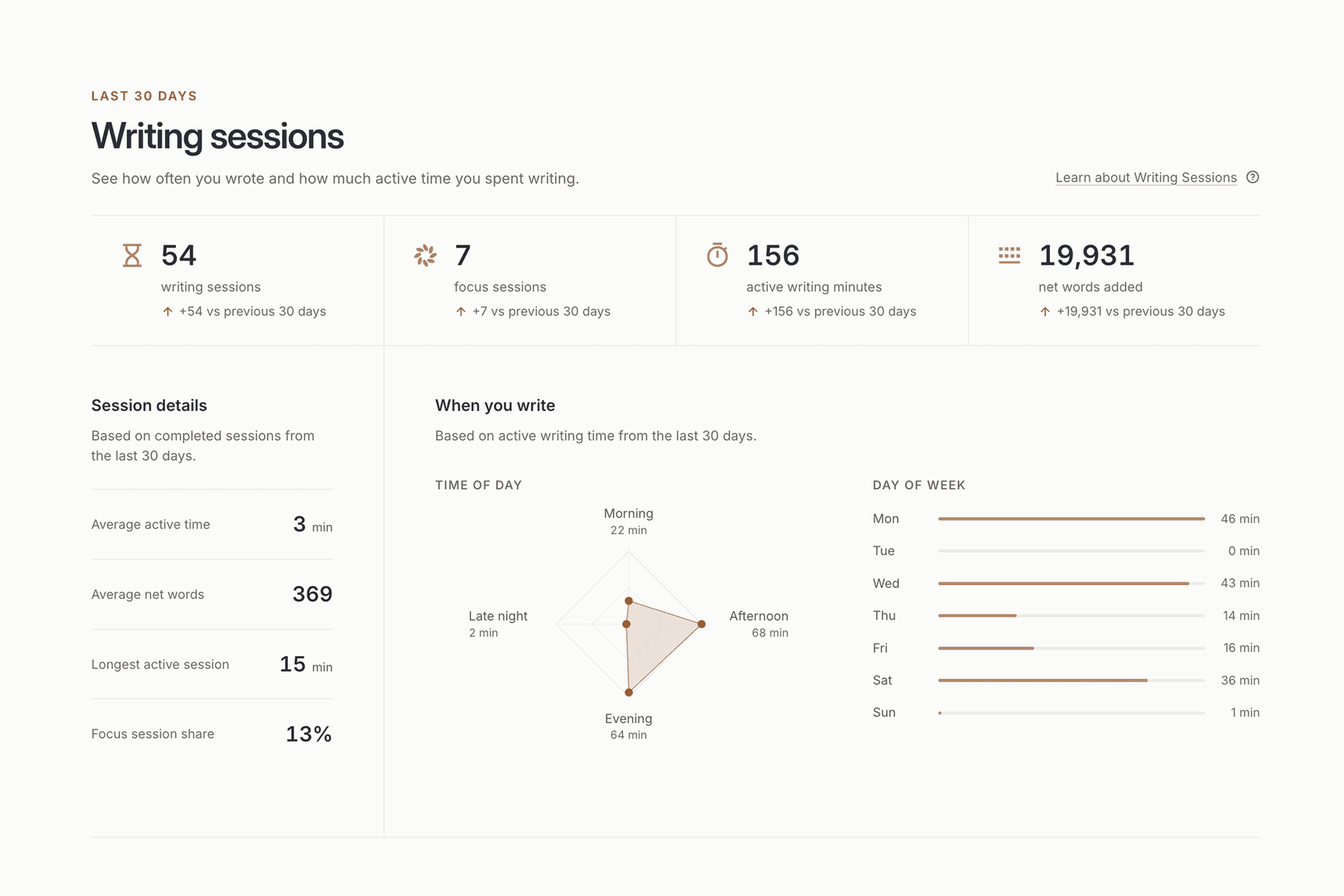
Writing Journey shows the hours when you tend to write. Treat this as evidence about your existing life. If most sessions begin between 8:00 and 10:00 p.m., ask what makes that window available. Dinner may be finished. Messages may be quieter. The household may have settled.
You do not have to keep that hour forever. You can test a nearby time and compare the result. But an existing pattern is a stronger starting point than an admired routine borrowed from another writer.
Usual writing time can also expose friction. If every session happens late at night even though you want to write earlier, look at the handoff into the session. Perhaps the draft has no next action. Perhaps opening it requires finding notes in three places. Fix the entry path before blaming your willpower.
Count returns before streaks
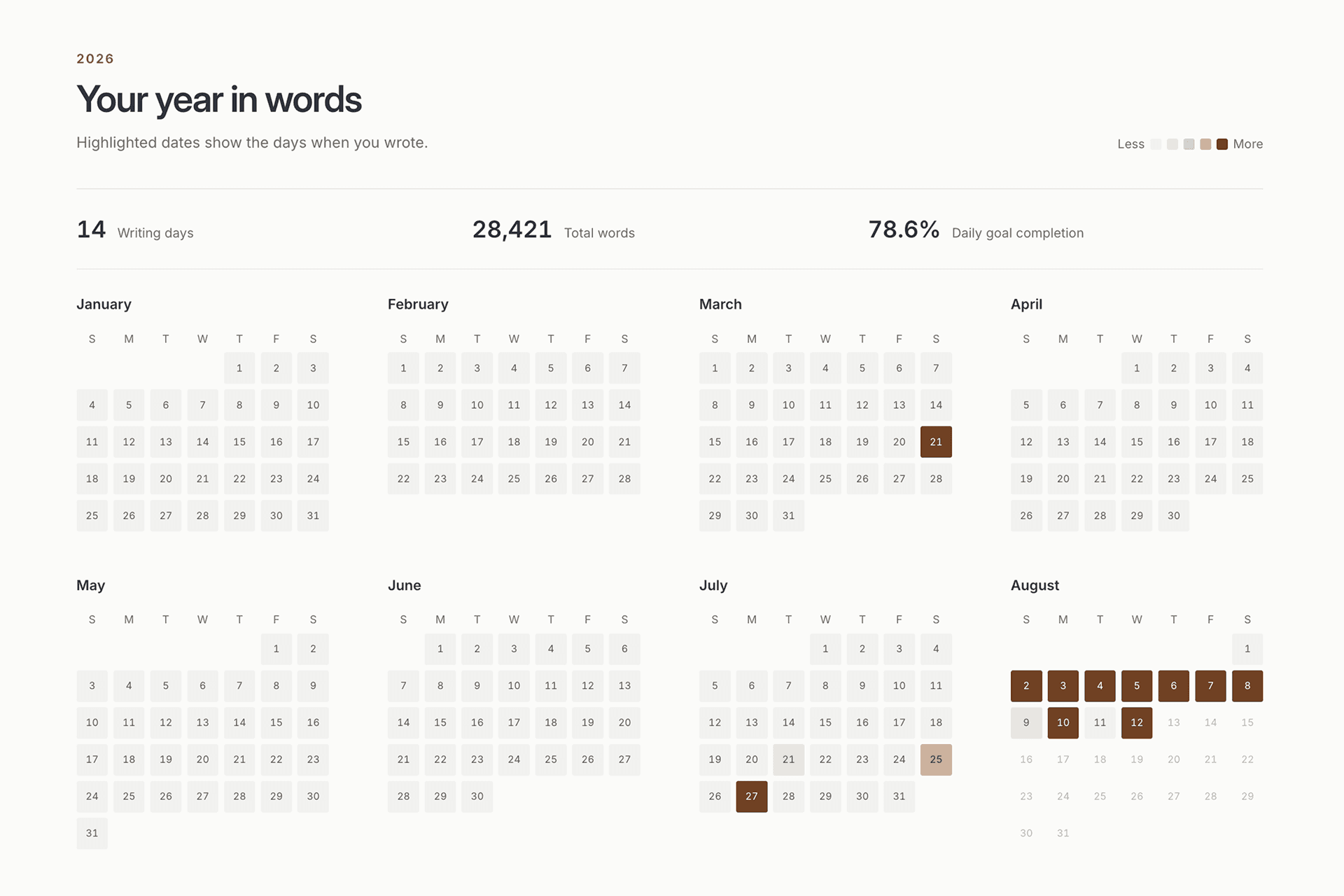
A streak can make repetition visible, but it gives adjacent days special importance. Writing on Monday and Wednesday may fit your life better than forcing a token sentence on Tuesday to protect a number.
Riikee distinguishes writing streaks from daily-goal streaks. The calendar shows what happened on each date, and Writing Journey keeps the longer history. A missed day can end a current streak, but it does not erase earlier pages, sessions, or achievements.
When a streak breaks, ask how quickly you returned. That answer often says more about the durability of the habit.
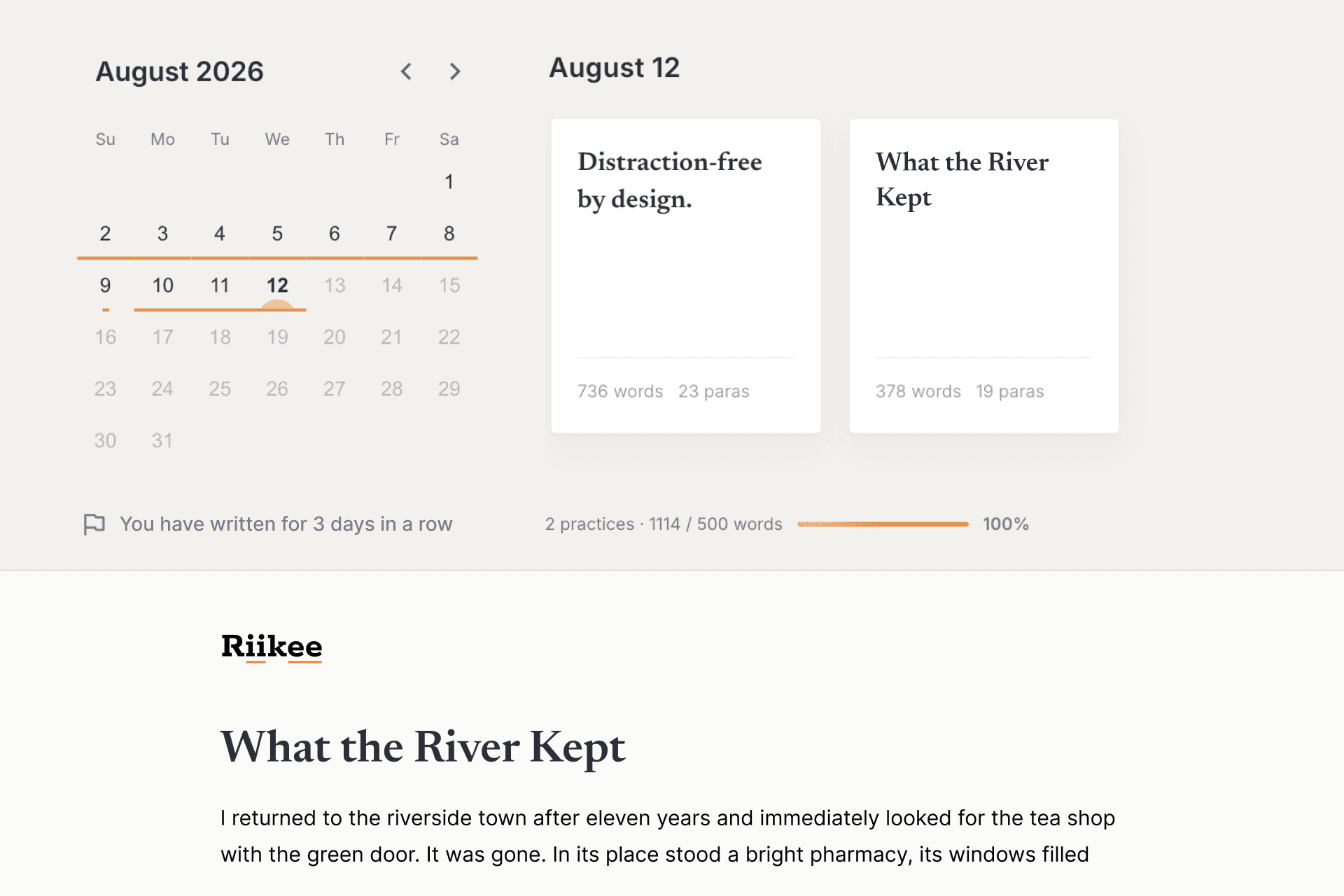
A useful weekly question is simple: "How many times did I come back?" It recognizes a practice that survives ordinary interruptions. If you write three times most weeks, plan around those three returns instead of comparing them with an imagined seven-day schedule.
Use goals as boundaries
A word count goal works best when it tells you when a session has done enough. It works poorly when it becomes a minimum measure of worth.
For a first draft, a retained-word goal can give the day a clear edge. For a difficult revision, time may be the better boundary because progress could require cutting or rearranging text. The article on choosing time or word count goals offers a fuller decision guide.
Change the goal when the phase changes. A single target does not need to govern research, drafting, structural revision, and proofreading. Keeping it fixed for the sake of consistency can make the tracker less truthful.
There is also no reward for setting the largest plausible number. A modest goal that gets you to the draft four times a week may produce more finished work than an ambitious one you avoid.
Read project progress in context
Long-form work needs another level of tracking. A general writing total may look healthy while the manuscript you care about receives no attention.
Riikee Projects show words written, remaining words, the number of Writings, writing days, active time, goal progress, a deadline, and time remaining. Statistics can also show top Projects by word count.
Use project data to make allocation decisions. If three active Projects divide every week into fragments, pause one. If the draft is near its target but several Sections remain empty, the structure matters more than the percentage bar. If a deadline requires a pace you have never sustained, change the scope or date while the choice is still available.
Project statistics should lead back to the work. End the review by opening one Writing and leaving a concrete next action. The system in organizing a long writing project is designed around that return.
Let achievements mark history
Riikee achievements cover consistency, retained words, writing days, completed Writing Sessions, Focus Sessions, and active time. They show recent milestones, nearby ones, a full collection, and personal records.
An achievement is most useful after it arrives. It marks something that already happened. Chasing the next badge can be pleasant, but it should not make you extend an exhausted session or choose easy words simply because the counter is close.
Some session-based achievements require an eligible completed session. Very short or incomplete sessions may appear in activity without counting toward every badge. Older active time cannot be reconstructed from document timestamps, so those records begin when Riikee started recording sessions.
Run a ten-minute weekly review
Choose a fixed day. Then use this short sequence:
- Write one sentence about what moved: "I drafted the middle scene and found the missing transition."
- Check writing days, active time, and the signal most relevant to the current phase.
- Compare the numbers with your memory. Note one surprise.
- Make one adjustment for the next week.
- Open the next Writing and leave a specific starting action.
The adjustment should be small enough to test. Move one session earlier. Reduce the daily goal for a revision week. Close a dormant Project. Put the source you need beside the paragraph that needs it.
If you change several parts of the routine at once, the next set of statistics will not tell you which change helped.
Notice when tracking makes writing harder
Stop reviewing the dashboard for a while if you check it more often than the draft, add filler to protect a word count, or avoid writing because the planned session is no longer long enough to look impressive.
You can keep a boundary without watching it continuously. Set a timer and hide the count. Review the week after it has happened. Replace a quantitative goal with a concrete task such as revising one scene or checking two sources.
The data belongs to the practice, not the other way around. A tracker has failed when maintaining the record consumes attention the writing needed.
Questions about tracking writing progress
What is the best way to track writing progress?
Choose a measure that matches the current phase. Retained words can help during drafting, active time can improve scheduling, and writing days can show whether you return. Pair the number with a brief note about what changed in the work.
Should I track words or time?
Track words when producing new material is the main task. Track time when revision, research, or difficult decisions may move the work without increasing its length. Many writers benefit from using both at different stages.
How often should I review writing statistics?
A weekly review is frequent enough to notice patterns without reacting to every session. Use a monthly or yearly view when you need to reconsider a larger goal or schedule.
Does deleting words mean I made no progress?
No. Cutting can improve structure, pace, and clarity. Riikee separates retained additions from net document change, so a revision session does not have to look productive only when the document gets longer.
What should I do when a writing streak breaks?
Return on the next workable day. Review what interrupted the routine and whether the schedule was realistic. The earlier writing remains part of your history even when the current streak ends.
Can writing statistics measure quality?
No. They can describe activity, frequency, length, and timing. They cannot decide whether a sentence is precise, an argument is sound, or a scene earns its place.
Track writing progress to answer practical questions. How often do you return? How much time does this work usually need? Which project is receiving attention? Once the numbers help you make the next session easier to begin, close the dashboard and go back to the page.