
You remember writing about the apartment once. Then you search the archive and find it in seven entries: the narrow kitchen, the neighbor upstairs, the view from the fire escape, the week before you moved.
The repetition was not planned. It became visible only after enough pages existed to compare.
That is the useful promise of writing analysis. It can help you notice what your memory smooths over: subjects you return to, forms you favor, and changes in the emotional weather of the text. The analysis becomes less useful when it starts to sound like a judgment about your personality or talent.
Riikee's Writing Portrait is built for the first kind of reading. It combines optional AI analysis from eligible practices across a selected period. The result is a map back into the writing, not a score for the writer.
What Writing Portrait analyzes
Writing Portrait does not begin by watching you type. It is assembled from saved practices that have already been analyzed.
When automatic writing analysis is enabled in Settings → AI, Riikee may analyze an eligible practice after your writing settles. A practice generally needs at least 150 words. The background analysis can wait when a system-wide limit has been reached, and it does not use the allowance for AI writing tools you start yourself.
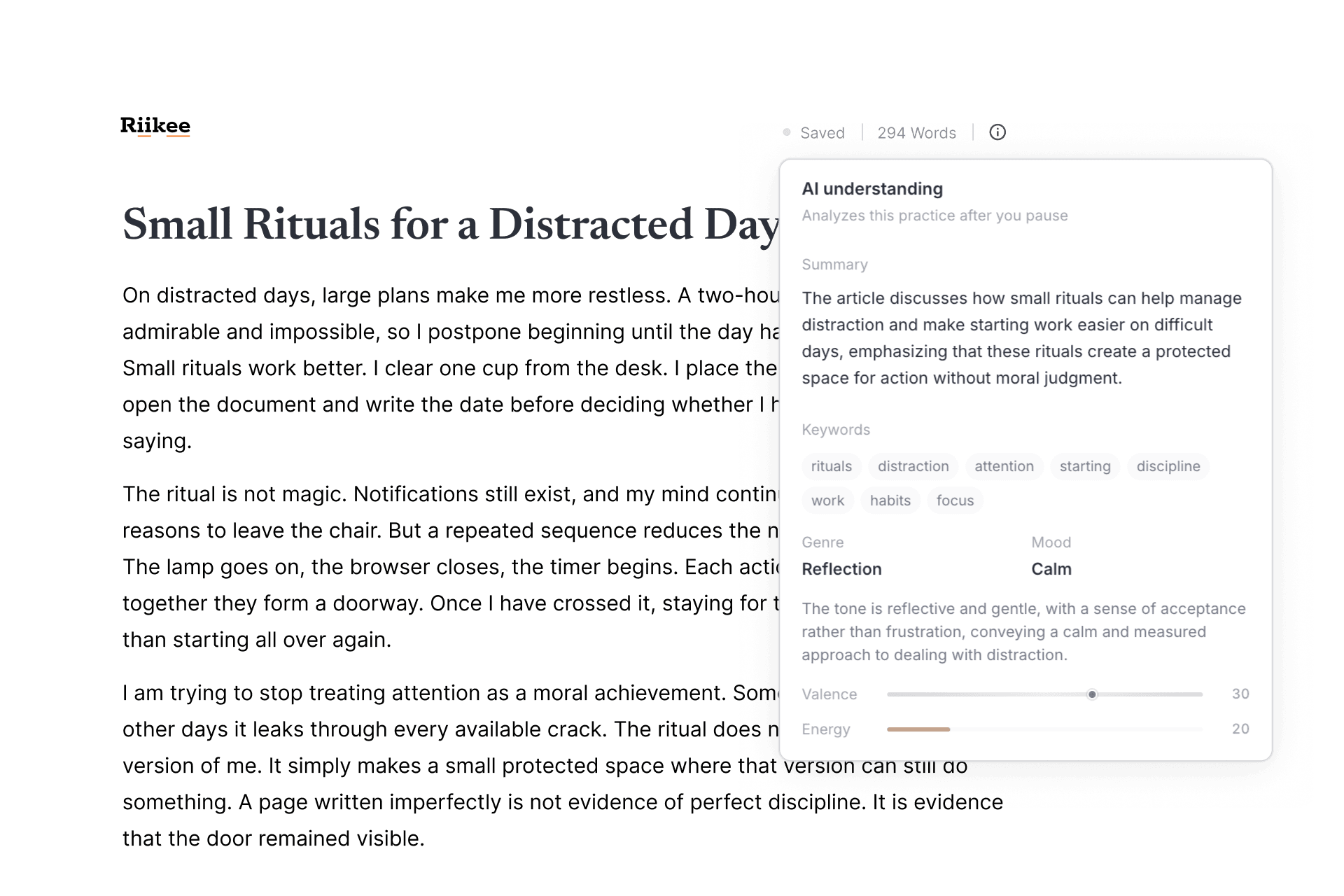
Depending on the text, a practice-level result may include:
- a short summary;
- keywords and themes;
- form or genre;
- written mood, emotional brightness, and energy;
- language and confidence in the analysis.
Not every result will contain every field. A page may also be too short or otherwise ineligible. This matters because Writing Portrait can describe only the material that reached the analysis stage. It is not a complete census of everything you have written.
The user path from one page to a portrait
The feature makes more sense when you follow the whole path.
- Write and save a practice.
- Enable automatic writing analysis if you want eligible practices processed in the background.
- Open Information on an analyzed practice to review its summary, themes, form, and written mood.
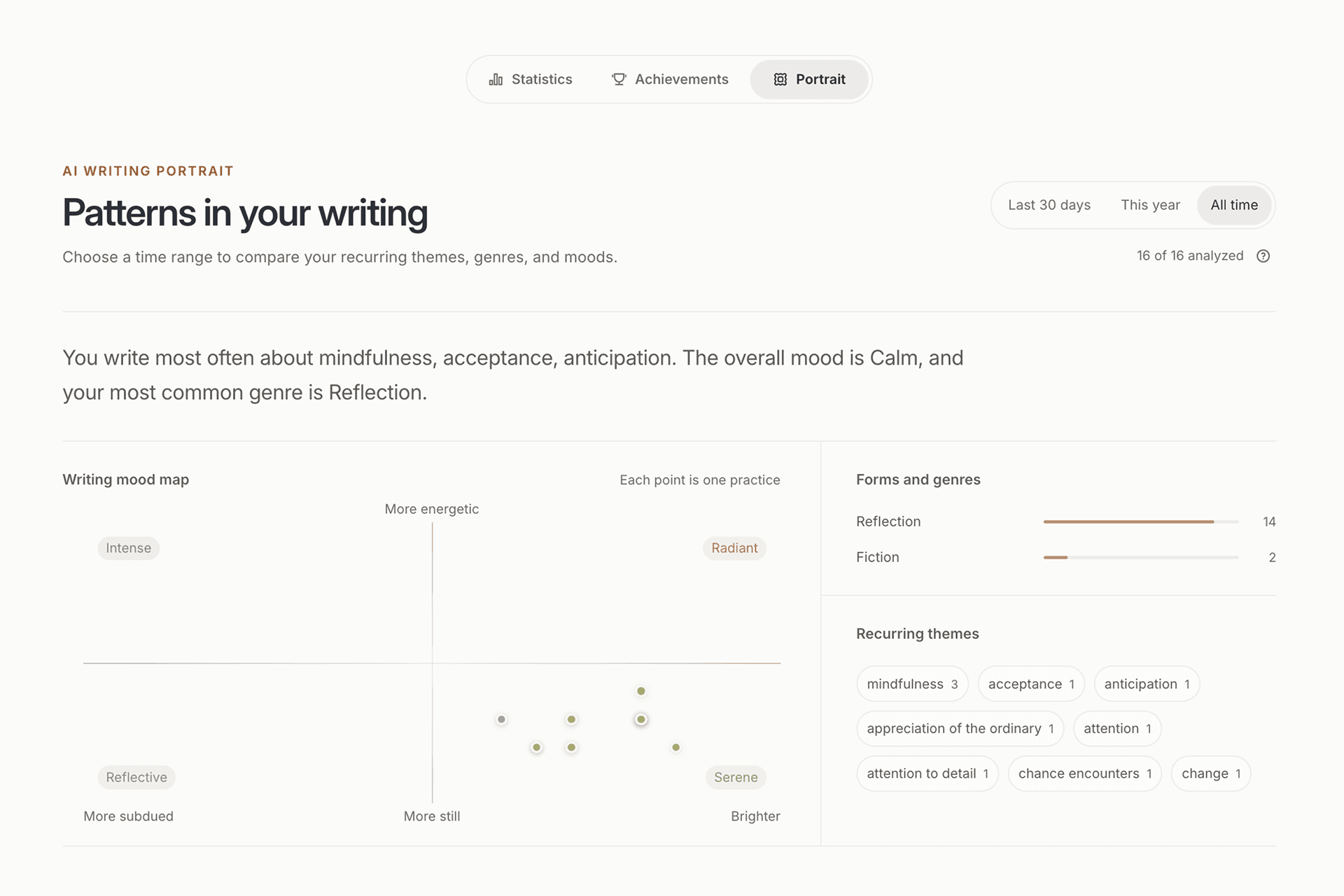
- Open Writing Journey → Portrait to compare analyzed practices across the last 30 days, this year, or all time.
- Select an observation or representative practice and return to the page itself.
That final step is the point. A label should create a reason to reread. If the system says that "departure" appears often, the next question is not whether departure defines you. The question is where it appears, what it means in those passages, and whether the pattern is real once you see the sentences together.
Use themes to recover unfinished threads
Writers abandon more ideas than they reject. A promising thread may disappear because it lived in a journal entry with an ordinary title, or because a new project took over before the thought was ready.
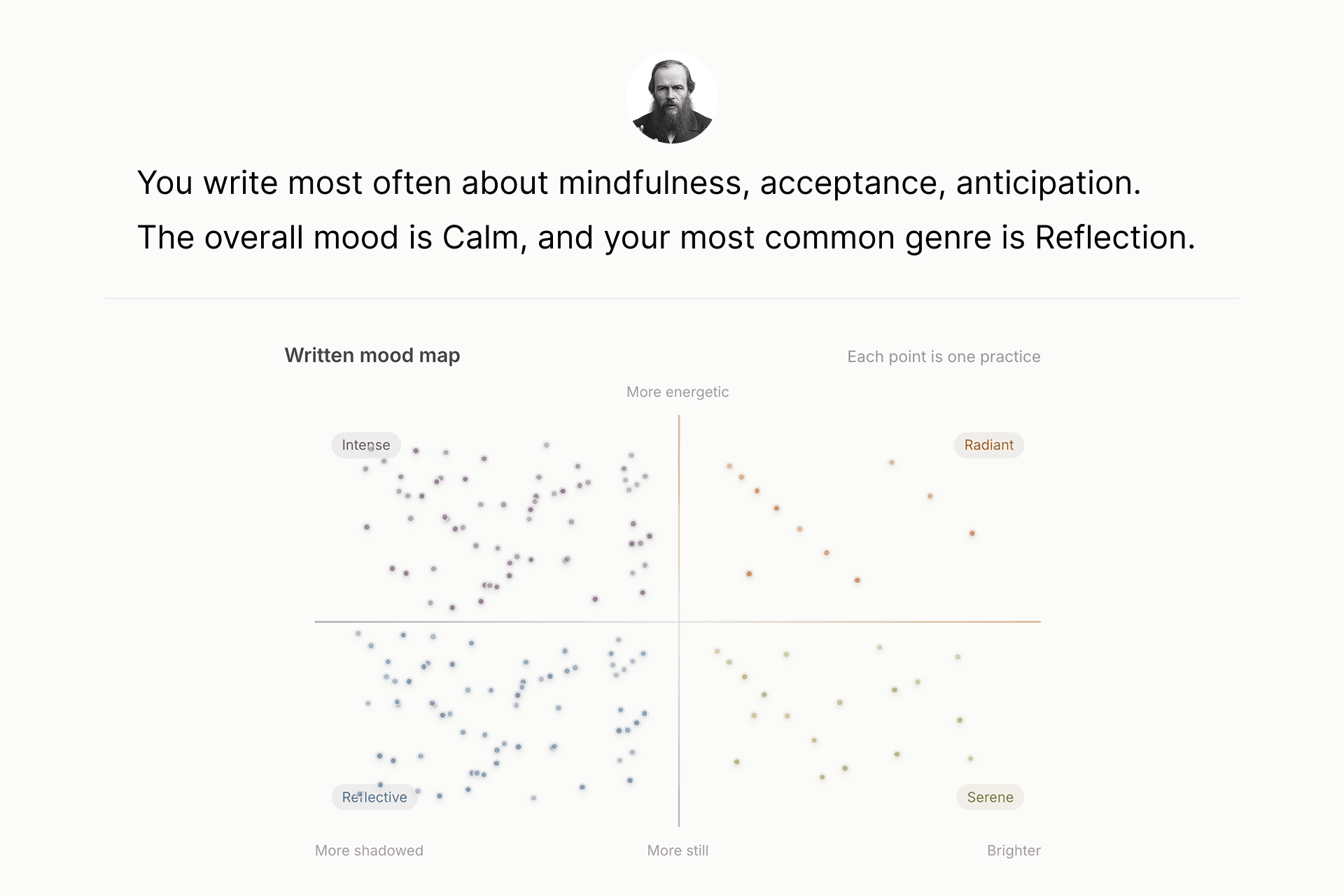
Recurring themes can make those threads findable again. Suppose several practices mention translation, belonging, and names. None of the pages is an essay, but the cluster suggests that the question has enough energy to support one.
Use a theme as a search term and reading list. Open two or three representative pages. Look for the sentence where the subject becomes specific. You may discover an argument, a scene, or a contradiction worth developing.
Do not begin by asking AI to write the missing essay. First recover your own language around the subject. The particular details in those pages are more useful than a general outline produced before you have reread them.
Compare forms, not only topics
A writing practice can become narrow without feeling repetitive. You may cover many subjects but always write them as explanation. Or you may collect vivid openings and stop before the page makes a claim.
Writing Portrait can show forms and genres that appear across analyzed work. Read these as working descriptions, not permanent categories. A personal essay may be labeled as reflection; a fictional monologue may look like a journal entry. AI classification is approximate.
Even an imperfect label can prompt a good review:
- Which forms appear because I enjoy them?
- Which appear because they feel safe?
- What form is missing from the subject I want to explore?
- Does one project account for most of the pattern?
If the portrait is full of short reflections, you might choose one and turn it into a scene. If it shows many explanatory essays, you might write the next idea as dialogue. The feature does not prescribe variety. It helps you choose it consciously.
Read written mood as a property of the page
Written mood describes language in the analyzed text. It does not establish how the author felt while writing.
This distinction is especially important for fiction. A tense scene should look tense. A mournful narrator may be doing exactly what the story needs. Even in a journal, one entry can record anger without describing the whole day or the person who wrote it.
Use mood, brightness, and energy to compare pages. You might notice that early drafts begin with high energy and later revisions become calmer. A project may contain ten subdued entries and one sharply comic page that suggests a missing tone. Those are observations about the writing.
Do not use the result as a mental-health assessment. Writing Portrait is not a psychological profile, diagnosis, or medical tool. If a label worries you, reread the source before giving it weight.
Choose a period that matches the question
Writing Portrait can combine analyzed practices across the last 30 days, the current year, or all time. The widest range is not automatically the most useful.
Use 30 days when you want to understand the project or season that currently occupies you. Recent work gives a sharper view of what is happening now, but a handful of entries can make one subject look larger than it is.
Use the year view when you want to compare phases of work. It can reveal whether a theme persisted after a project ended or whether your preferred form changed with a new routine.
Use all time when the archive is large enough to make recurrence meaningful. Older and newer analyses may also reflect changes in available data or system behavior, so treat long-range comparisons as exploratory rather than exact measurement.
A monthly Writing Portrait review
The feature does not need to become another dashboard you check after every paragraph. A monthly review is enough for most writers.
Start with one question. "What should I write next?" is better than "What does my writing say about me?"
Then spend fifteen minutes on this sequence:
- Open the 30-day view and note one recurring theme or form.
- Open two practices connected to it.
- Copy one sentence from each into a new note or Writing.
- Write your own explanation of the connection before asking AI for help.
- Choose one next action: continue a page, combine two fragments, or leave the pattern alone.
The review produces a writing decision rather than a personality report. Some months the correct decision will be "nothing here yet." That is still better than forcing every cluster into a project.
Let contradictions remain visible
Aggregated insights tend to compress. A portrait may say that a theme recurs while hiding the fact that your position changed each time. It may combine sadness in fiction with sadness in a journal. It may put a travel note and a political essay under the same broad topic.
Return to representative pages and look for disagreement. Did the meaning of "home" shift after the move? Does the comic piece resist the solemn ones? Is the repeated genre really one long project rather than a general preference?
Contradictions are often more useful than a clean summary. They give the next piece something to do.
Keep automatic analysis under your control
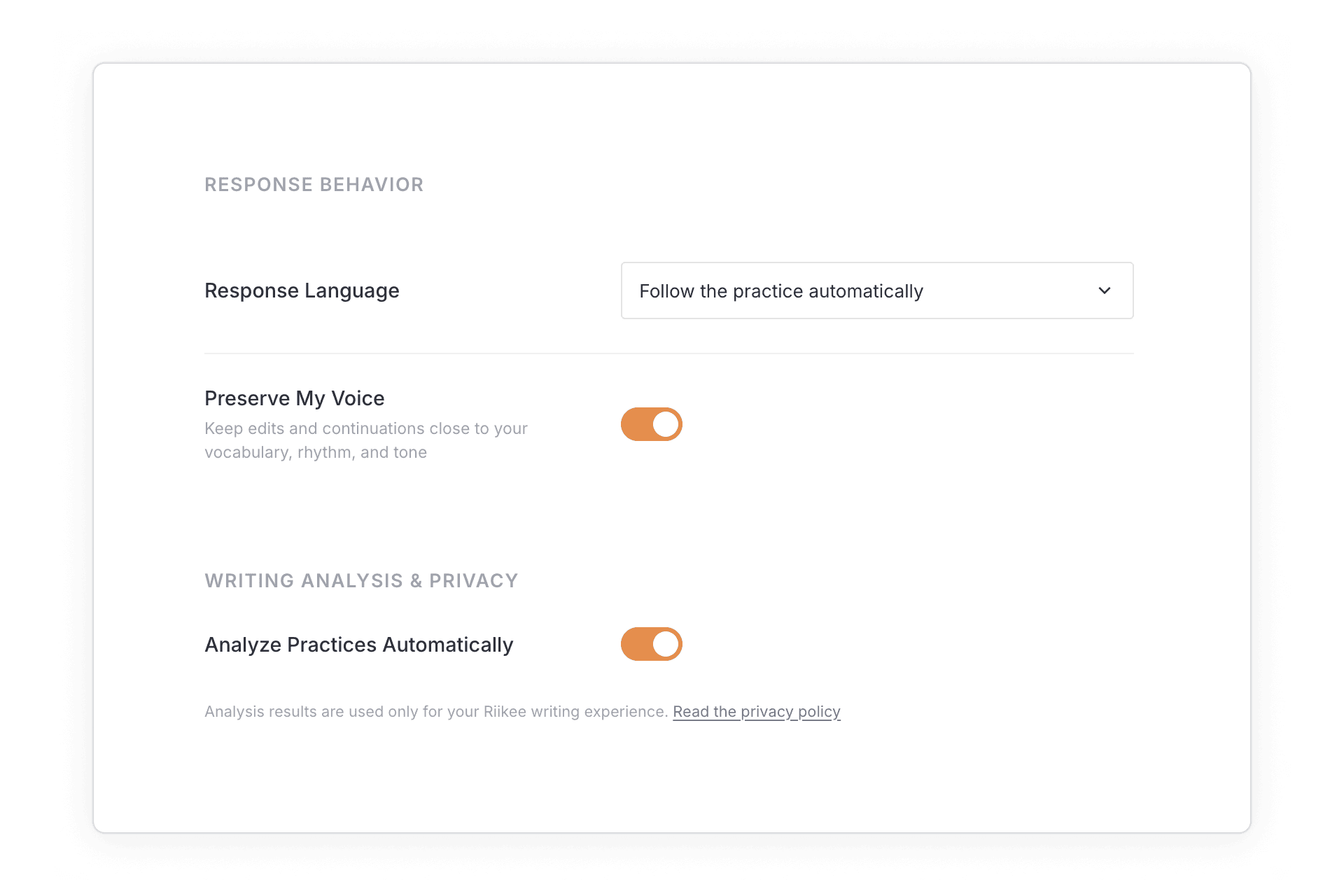
Automatic analysis is optional. Turn it off in Settings → AI to stop new background analyses. Existing results remain until the related writing or account is deleted, or until a newer result replaces them.
When analysis is enabled, Riikee processes eligible writing and stores a structured result. AI requests may use third-party model and infrastructure providers as described in the Riikee Privacy Policy. Riikee does not use your writing to train its own AI models.
This is not end-to-end encrypted analysis. If a piece should not be processed by an AI provider, leave automatic analysis off and do not submit that text to an AI command. You can still use Riikee as a writing space without Writing Portrait.
What Writing Portrait cannot tell you
Writing Portrait cannot tell you whether a page is good. It does not know whether a repeated image is deliberate, whether a character's mood serves the scene, or whether an argument is true.
It also cannot reliably describe you as a person. Text is shaped by assignment, genre, narrator, project, revision stage, and the small set of experiences you happened to record. An archive is evidence of writing, not a transparent copy of a life.
The analysis can be incomplete or wrong. Confidence is still not proof. A high-confidence label may miss irony, cultural context, or the relation between a fragment and the project around it.
Use the portrait when it shortens the path back to your own pages. Ignore it when it makes the writing feel less specific than it was.
Questions about AI writing analysis
What is Riikee Writing Portrait?
Writing Portrait is a view inside Writing Journey that combines analyzed practices across a selected period. It can show recurring themes, forms, genres, and written moods with routes back to representative pages.
Does Riikee analyze everything I write?
No. Automatic analysis must be enabled, the practice must be saved and eligible, and it generally needs at least 150 words. Processing can also wait when the system-wide limit has been reached.
Does background analysis use my AI allowance?
No. Background analysis does not use the allowance for AI writing tools you initiate, although separate system limits can delay it.
Is Writing Portrait a psychological profile?
No. It describes patterns in analyzed text. It is not a diagnosis, medical assessment, or reliable statement about your personality.
Can I turn it off?
Yes. Turn off automatic writing analysis in Settings → AI to stop new background analyses. Existing results remain until the related writing or account is deleted, or the analysis is replaced.
Can the analysis be wrong?
Yes. AI results can be incomplete or mistaken. Open the source writing and decide whether the observation survives contact with the page.
How much writing do I need before the portrait is useful?
There is no fixed number of practices. A few analyzed pages can describe a recent project, while recurring patterns need a broader sample. Begin with the 30-day view and treat any strong claim based on limited material cautiously.
Your archive already contains choices you have forgotten making. Writing Portrait can help you find them, but the interesting work begins after the label, when you reopen the sentences and decide what they mean together.